

how to find total assets
What are Total Assets?
Total Assets, most commonly used in the context of a corporation, is defined as the assets owned by the entity that has an economic value whose benefits can be derived in the future. Assets are recorded in the balance sheet Assets in accounting refer to the organization's resources that hold specific economic value and facilitate business operations, meet expenses, and generate cash flow. They create the company's worth and are recorded in the balance sheet. read more of the firm.
- Assets are further classified into liquid assets Liquid Assets are the business assets that can be converted into cash within a short period, such as cash, marketable securities, and money market instruments. They are recorded on the asset side of the company's balance sheet. read more and illiquid assets, depending on their liquidity. A liquid asset is that asset that can be easily converted into cash or readily sold for cash; otherwise, it is called an Illiquid asset.
- Assets are also classified on the balance sheet as either current assets Current assets refer to those short-term assets which can be efficiently utilized for business operations, sold for immediate cash or liquidated within a year. It comprises inventory, cash, cash equivalents, marketable securities, accounts receivable, etc. read more or long-term assets. A current asset is that asset which can be liquidated within a year, whereas long-term assets are those assets that are liquidated in more than a year.
Total Assets Types
Here is the list of total asset types
- Cash & cash equivalents
- Marketable securities Marketable securities are liquid assets that can be converted into cash quickly and are classified as current assets on a company's balance sheet. Commercial Paper, Treasury notes, and other money market instruments are included in it. read more
- Account Receivables Accounts receivables refer to the amount due on the customers for the credit sales of the products or services made by the company to them. It appears as a current asset in the corporate balance sheet. read more
- Prepaid Expenses Prepaid expenses are expenses for which the company paid in advance in an accounting period but which were not used in the same accounting period and have yet to be recorded in the company's books of accounts. read more
- Inventory
- Fixed Assets Fixed assets are assets that are held for the long term and are not expected to be converted into cash in a short period of time. Plant and machinery, land and buildings, furniture, computers, copyright, and vehicles are all examples. read more
- Intangible Assets Intangible Assets are the identifiable assets which do not have a physical existence, i.e., you can't touch them, like goodwill, patents, copyrights, & franchise etc. They are considered as long-term or long-living assets as the Company utilizes them for over a year. read more
- Goodwill In accounting, goodwill is an intangible asset that is generated when one company purchases another company for a price that is greater than the sum of the company's net identifiable assets at the time of acquisition. It is determined by subtracting the fair value of the company's net identifiable assets from the total purchase price. read more
- Various other assets
Formula
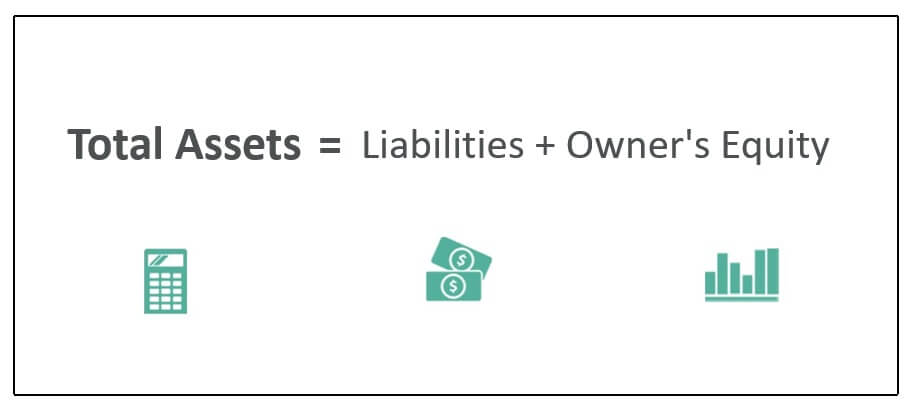
Basic Formula in accounting is expressed as:-
Total Assets = Liabilities + Owner's Equity
You are free to use this image on your website, templates etc, Please provide us with an attribution link Article Link to be Hyperlinked
For eg:
Source: Total Assets (wallstreetmojo.com)
The equation must balance because everything the firm owns must be purchased from debt (liabilities) and capital (Owner's or Stockholder's Equity).
The extended accounting equation Accounting Equation is the primary accounting principle stating that a business's total assets are equivalent to the sum of its liabilities & owner's capital. This is also known as the Balance Sheet Equation & it forms the basis of the double-entry accounting system. read more , after considering sales revenue and expenses, is expressed as:-
Assets = Liabilities + Owner's Equity + (Revenue – Expenses) – Draws
Examples of Total Assets
The following are examples of Total Assets
You can download this Total Assets Excel Template here – Total Assets Excel Template
Example #1
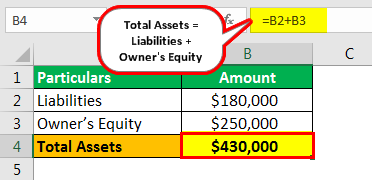
If a business owns a piece of real estate where the owner's equity worth $250,000, and they owe $180,000 on loan for that real estate, what is the value of Assets?
Solution –
Given,
- Liabilities=$180,000
- Owner's Equity=$250,000
Therefore, the calculation of total assets will be
Example #2
The summaries of the balance sheet and income statement data follow.
- Beginning of the Year – assets $ 85,000, Total liabilities $62,000, Total owner's equity?
- End of Year – assets $110,000, Total owner's equity $60,000, Total liabilities?
- Changes during the year in the owner's equity – Investments by owner? Drawings $18,000,Total revenues $175,000, Total expenses $140,000.
Solution
1) Beginning of Year
Therefore, the calculation of total owner's equity using below formula is
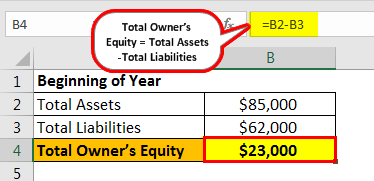
- = $85,000-$62,000
- Total Owner's Equity=$23,000
2) End of Year
Therefore, the calculation of total liabilities using below formula is
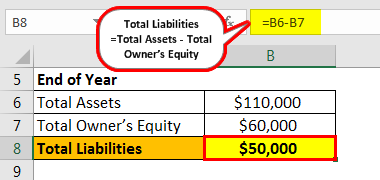
- Total Liabilities=$110,000-$60,000
- Total Liabilities=$50,000
3) Changes during the Year in Owner's Equity
Opening Balance $23,000, Investments by owner?, Drawings -$18,000,Total revenues +$175,000, Total expenses -$140,000, Closing Balance $60,000.
Therefore, the calculation of owner's investment using below formula is
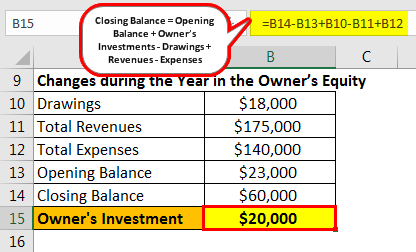
Closing Balance = Opening Balance + Owner's Investments – Drawings + Revenues – Expenses
- $60,000=$23,000+ Owner's Investments-$18,000+$175,000-$140,000
- =$60,000-$23,000+$18,000-$175,000+$140,000
- Owner's Investments=$20,000
Example #3
A co. owner's equity is 1/3 of its total assets. Its liabilities $200,000.What is the total assets?
Given,
- Liabilities=$200,000
- Owner's Equity = 1/3*Assets=1/3 *A
- Total Assets Formula Total Assets is the aggregate of liabilities and shareholder funds. It can also be computed by combining current and noncurrent assets. read more = Owner's Equity+ Liabilities
Solution
- A= 1/3 *A+$200,000
- A- 1/3*A = $200,000
- 2/3*A = $200,000
- A= $100,000*3
- A = $300,000
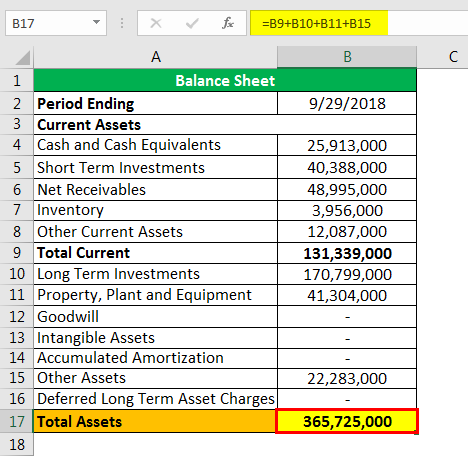
Example #4
Preparing a Balance Sheet A balance sheet is one of the financial statements of a company that presents the shareholders' equity, liabilities, and assets of the company at a specific point in time. It is based on the accounting equation that states that the sum of the total liabilities and the owner's capital equals the total assets of the company. read more
Advantages
Now, let us have a look at some of its advantages
- It can be used at any time to repay liabilities.
- Current Assets, on the one hand, can be easily converted for liquid cash whereas, on the other hand, Long Term Assets can be used as a mortgage to support working capital.
- Assets help in improving the valuation of the firm. More Assets, fewer liabilities mean more valuable firm.
- Accounts Receivables are another important part of Assets, which helps in building good relationships with various clients, which allows clients to purchase on credit and pay later.
- Various business deals like Mergers and Acquisitions A merger and acquisitions (M&A) agreement refers to an agreement between two existing companies to merge into a new company, or the purchase of one company by another, which is done generally to benefit from the synergy between the companies, expand research capacity, expand operations into new segments, and increase shareholder value, among other things. read more , Tie-ups, etc. assets play a vital role, as every decision is taken by considering the firm's assets.
- Leasing or renting assets such as machinery or office equipment can save you the initial costs of buying them outright.
Disadvantages
Now, let us have a look at some its disadvantages
- Depreciation in Value of Fixed Assets over the years.
- One can't claim capital allowances on a leased asset if the lease period is less than 5 years.
- In the case of non-repayment of liabilities, the mortgaged asset can be auctioned by the bank in order to collect the loan amount.
- Sometimes assets become non- performing assets Non-Performing Assets (NPA) refers to the classification of loans and advances on a lender's records (usually banks) that have not received interest or principal payments and are considered "past due." In the majority of cases, debt has been classified as non-performing assets (NPAs) when loan payments have been outstanding for more than 90 days. read more , and maintenance or written-off of such assets Write off is the reduction in the value of the assets that were present in the books of accounts of the company on a particular period of time and are recorded as the accounting expense against the payment not received or the losses on the assets. read more cost more to firms.
Applications of Total Assets
They are used in calculating Various ratios like Net assets, ROTA (Return on Total Assets), RONA Return on net assets determines the efficiency of the company's net assets to generate profit. It analyzes the income-generating ability of the net working capital and the fixed assets employed in the business. read more (Return on Net Assets), Asset Turnover Ratio The asset turnover ratio is the ratio of a company's net sales to total average assets, and it helps determine whether the company generates enough revenue to justify holding a large amount of assets under the company's balance sheet. read more , DuPont Analysis, etc.
#1 – Net Assets – This is a difference between Total Assets and Total Liabilities.
Net Assets = Total Assets – Total Liabilities
#2 – ROTA – Return on Total Assets is calculated as the ratio of Net income to the total value of its assets.
ROTA = Net Income / Total Assets
#3 – RONA – Return on Net Assets is calculated as
RONA = Net Income / Fixed Assets + Net Working Capital
#4 – Asset Turnover Ratio – This is an activity ratio Activity Ratios measure the organizational efficiency to utilize its various operating assets (as shown in the balance sheet) to generate sales or cash. It includes inventory turnover ratio, total assets turnover ratio, fixed asset turnover ratio and accounts receivable turnover ratio. read more , which is calculated as:-
Asset Turnover Ratio = Net Sales / Total Assets
#5 – DuPont Analysis – Asset Turnover ratio is used to perform DuPont Analysis.
DuPont formula DuPont formula determines the return on equity (ROE), depicting the efficient utilization of shareholders' capital into the business for generating revenue. The formula is "Return on Equity (ROE) = Profit Margin * Total Asset Turnover * Leverage Factor". read more analysis is a useful method used to decompose the various drivers of return on equity (ROE). Fragmentation of ROE allows investors to focus on the key metrics of financial performance individually to identify strengths and weaknesses. These metrics of financial performance are:-
- Operating Efficiency – It is represented by Profit Margin Profit Margin is a metric that the management, financial analysts, & investors use to measure the profitability of a business relative to its sales. It is determined as the ratio of Generated Profit Amount to the Generated Revenue Amount. read more .
- Asset Use Efficiency -It is represented by Asset Turnover Ratio.
- Financial Leverage -It is represented as Equity Multiplier The equity multiplier is a simple ratio of total assets to total equity that helps us understand how much of the company's assets are financed by shareholder equity. If this ratio is higher, the financial leverage (total debt to equity) is higher and vice versa. read more .
Conclusion
Asset plays a significant role in the vast study of the financial world. Individuals or Entities should hold more Assets and fewer liabilities in order to improve their market value and their sustainability for the future. In order to get more projects in future, the company should look healthy, and a firm's health will be decided on various parameters among which "Asset" is the most crucial one, as it will help in predicting the range of profit firm can earn on their current investment over the period of time.
Recommended Articles
This has been a guide to what is Total Assets and its definition. Here we discuss the types of total assets along examples and its applications. You can learn more about accounting from the following articles –
- Statement of Owner's Equity
- Net Assets Examples
- Calculate Asset Turnover Ratio
how to find total assets
Source: https://www.wallstreetmojo.com/total-assets/
Posted by: fremontmosty1989.blogspot.com
0 Response to "how to find total assets"
Post a Comment